
Aerial drone view of potato farm rows at golden hour, harvester trailing dust across umber soil
Season 2025–26Lincolnshire · 1,000 ac · Est. 1987

From Our Soil
to Your Supply Chain

Maris Piper, Rooster, and King Edward grown on heavy clay — graded, cold-stored, and dispatched with full traceability documentation.

1,000Acres
3Named Varieties
20 tMin Order
100%Traceable
GlobalG.A.P.Certified
Certifications:
GlobalG.A.P.Good Agricultural Practice
Red TractorFarm Assured
LEAF MarqueIntegrated Farm Management
BRCGSFood Safety Grade AA
TUBER
The Full Lifecycle

Seed to Supply Chain,
Every Step Documented

We publish the numbers because buyers who know what those numbers mean trust a grower who doesn't hide them. Scroll through the full crop year.
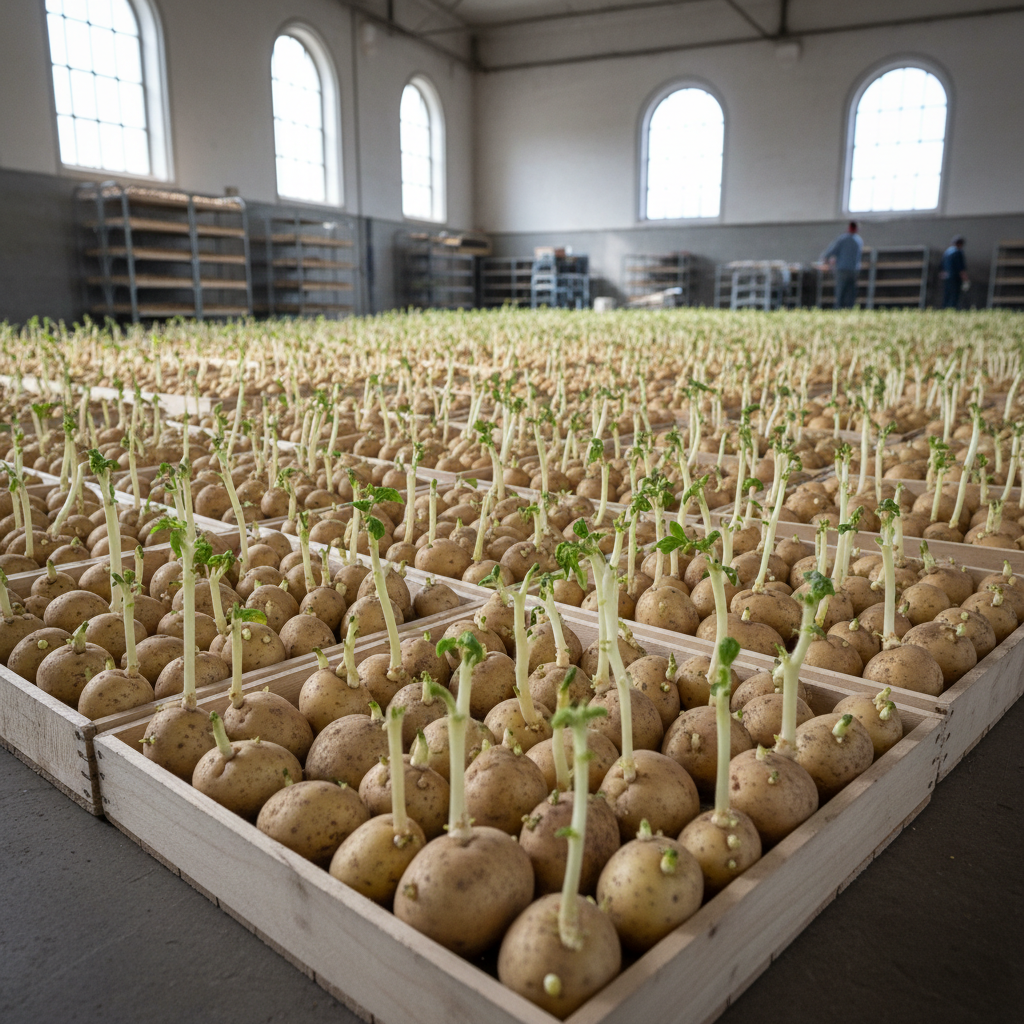

Seed potato trays lined up in a cool, light building showing chitting shoots emerging from pale tubers
January
Stage 01 — Seed Selection

Seed Selection & Chitting

The crop is decided before the first furrow is cut.

We source certified seed stock from accredited Scottish and Irish growers, inspected for blight-free status and stored at 4 °C until January. Each seed lot is tested for dry-matter content before acceptance — Maris Piper seed must return above 21% to make the cut. Chitting begins in mid-January: trays are racked in a light, frost-free building at 8–10 °C to encourage short, dark chits before spring planting.

4 °CSeed store temp±0.5 °C tolerance
21%Min dry matterMaris Piper seed
15 mmTarget chit lengthPre-plant

Operational Detail

Seed storage temperature: 4 °C ±0.5 °C. Chitting temperature: 8–10 °C. Minimum chit length target before planting: 15 mm. Seed lot traceability retained for 5 years post-harvest. Certified seed purchase invoices held on file for GlobalG.A.P. audit.

Stage 02 — Planting

Planting & Ridge Formation

Clay waits for no calendar. It waits for soil temperature.

On heavy clay, planting before soil temperature reaches 7 °C risks seed-piece rotting and uneven emergence. We monitor soil temperature at 100 mm depth across three field zones from 1 March, and planting begins only when a stable 7 °C is confirmed for five consecutive days. Ridges are formed at 900 mm centres using a six-row ridger, with seed placed at 300 mm spacing for Maris Piper and 350 mm for King Edward.

7 °CMin soil temp5-day average
900 mmRidge centresClay optimised
42,000Plants/ha maxKing Edward

Operational Detail

Soil temperature threshold: 7 °C at 100 mm depth, 5-day rolling average. Ridge centres: 900 mm. Seed spacing: Maris Piper 300 mm, Rooster 320 mm, King Edward 350 mm. Planting depth: 100–120 mm to ridge crown. Target plant population: 37,000–42,000 plants/ha.

Tractor forming parallel ridges across a large clay field in early spring, soil freshly turned dark brown
April
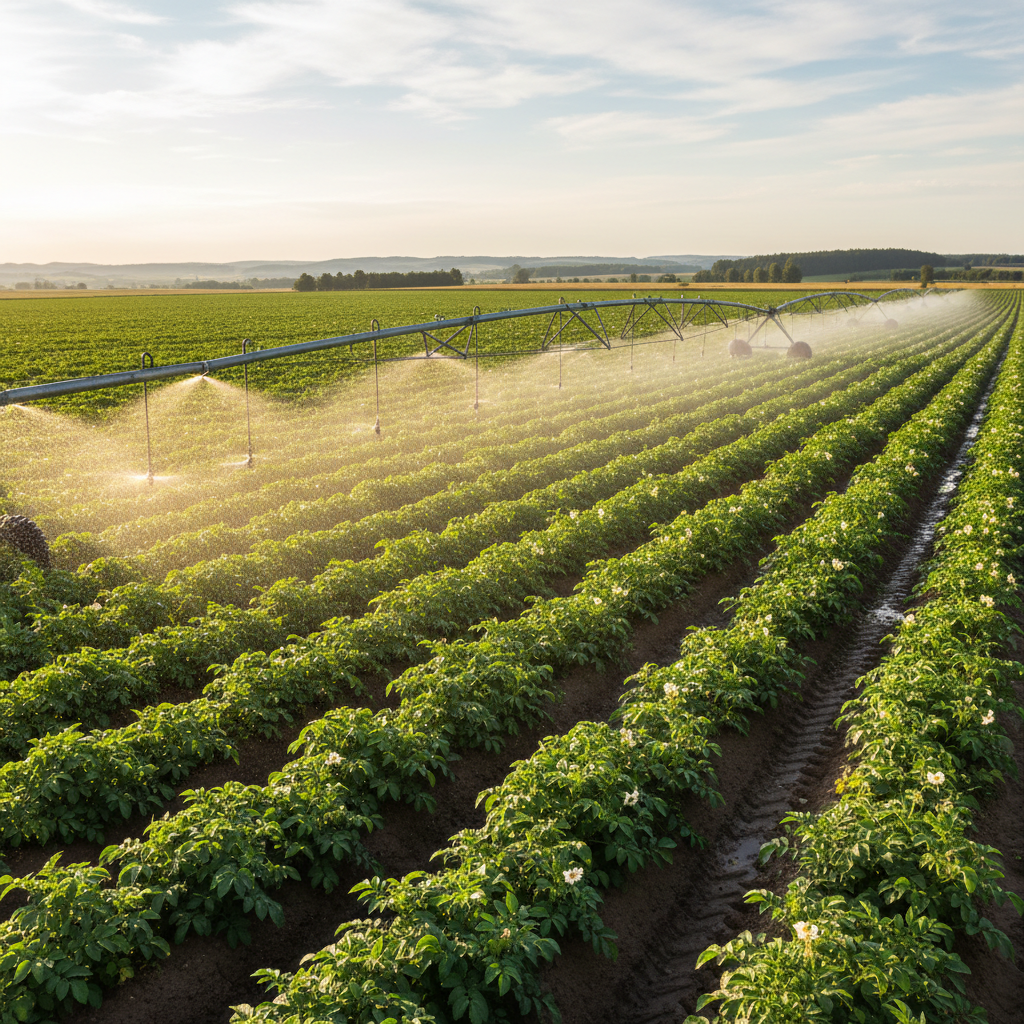
Irrigation boom moving across green potato rows in summer, fine spray catching golden afternoon light
June–August
Stage 03 — Summer Management

Blight Management & Irrigation

Phytophthora infestans does not take weekends off.

Potato blight remains the single largest yield threat on Lincolnshire clay. We run a 7-day spray programme from canopy closure, using a curative/protectant rotation to manage resistance. All fungicide applications are logged with product, rate, application date, and withdrawal period — this data is available in the spec sheet. Irrigation is triggered at 50% available water deficit, targeting precisely the tuber initiation window to suppress common scab on Maris Piper.

7 daySpray intervalFrom canopy closure
14 dayMax withdrawalPre-harvest
50%AWD triggerIrrigation threshold

Operational Detail

Fungicide programme: 7-day intervals from canopy closure. Products rotated across FRAC groups 4, 11, and 45. Maximum withdrawal period in programme: 14 days pre-harvest. Irrigation trigger: 50% AWD. Scab suppression window: 4 weeks post-tuber initiation. All applications recorded to GlobalG.A.P. standard.

Stage 04 — Harvest & Grading

Harvest & Grading

The harvester grades as it goes. The numbers are published.

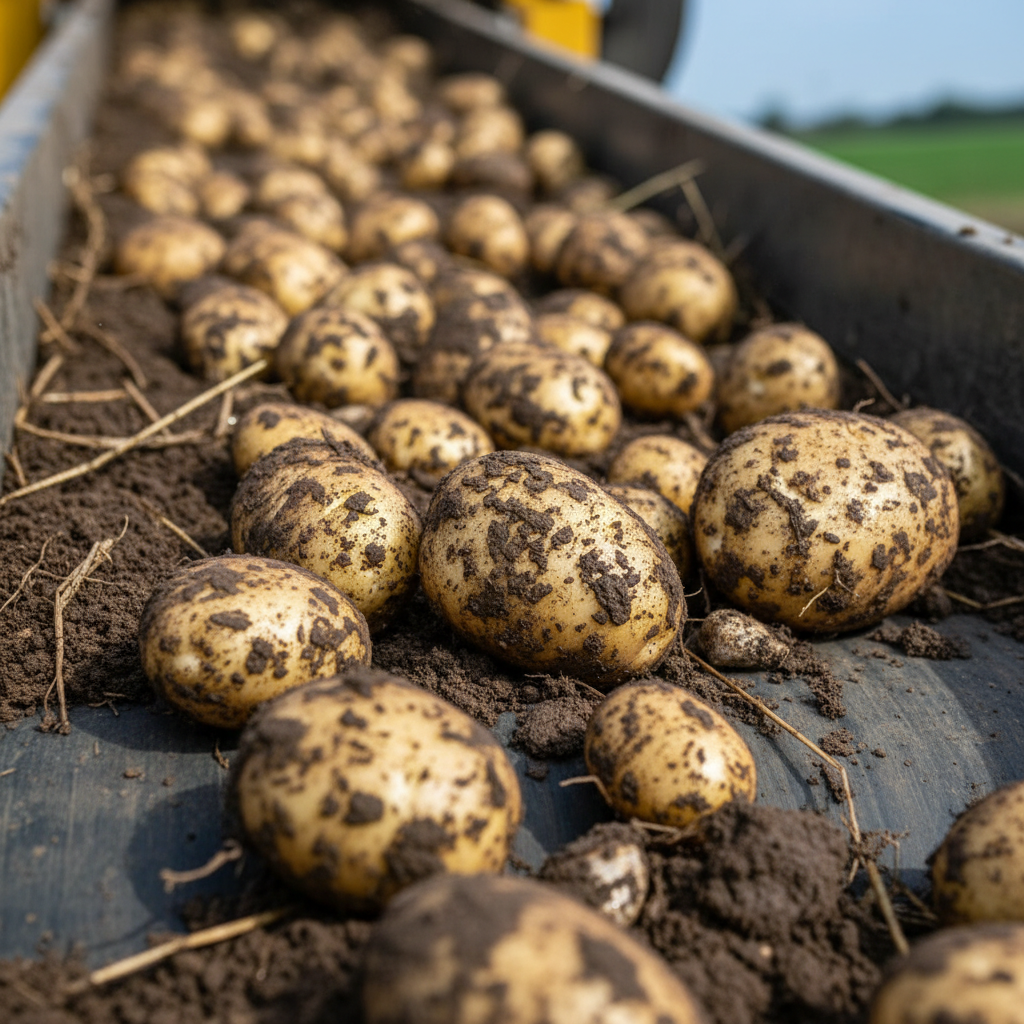
Harvesting begins when skin set is confirmed — a thumb-rub test on a sample of 20 tubers per field zone, targeting zero skin slip. A two-row harvester with web separation removes clods and stones before elevator delivery. Tubers pass over a 35 mm and 75 mm riddle to produce our standard wholesale grade. All out-of-grade material is weighed and recorded. Bruise monitoring uses IMPACT recorders run at start-up and after each blockage clearance.

35–75Grade range (mm)Standard wholesale
3%Max bruiseBy weight
±5 mmSize toleranceStated grade

Operational Detail

Skin set standard: zero slip on 20-tuber sample. Harvest grade: 35–75 mm standard, 45–75 mm premium chip. Bruise tolerance: maximum 3% by weight. Out-of-grade recording: mandatory per field. IMPACT recorder data retained per harvest day. Grading tolerance: ±5 mm on stated size.

Close-up of freshly harvested potatoes moving along a harvester conveyor belt, soil-covered and pale fleshed
September–October
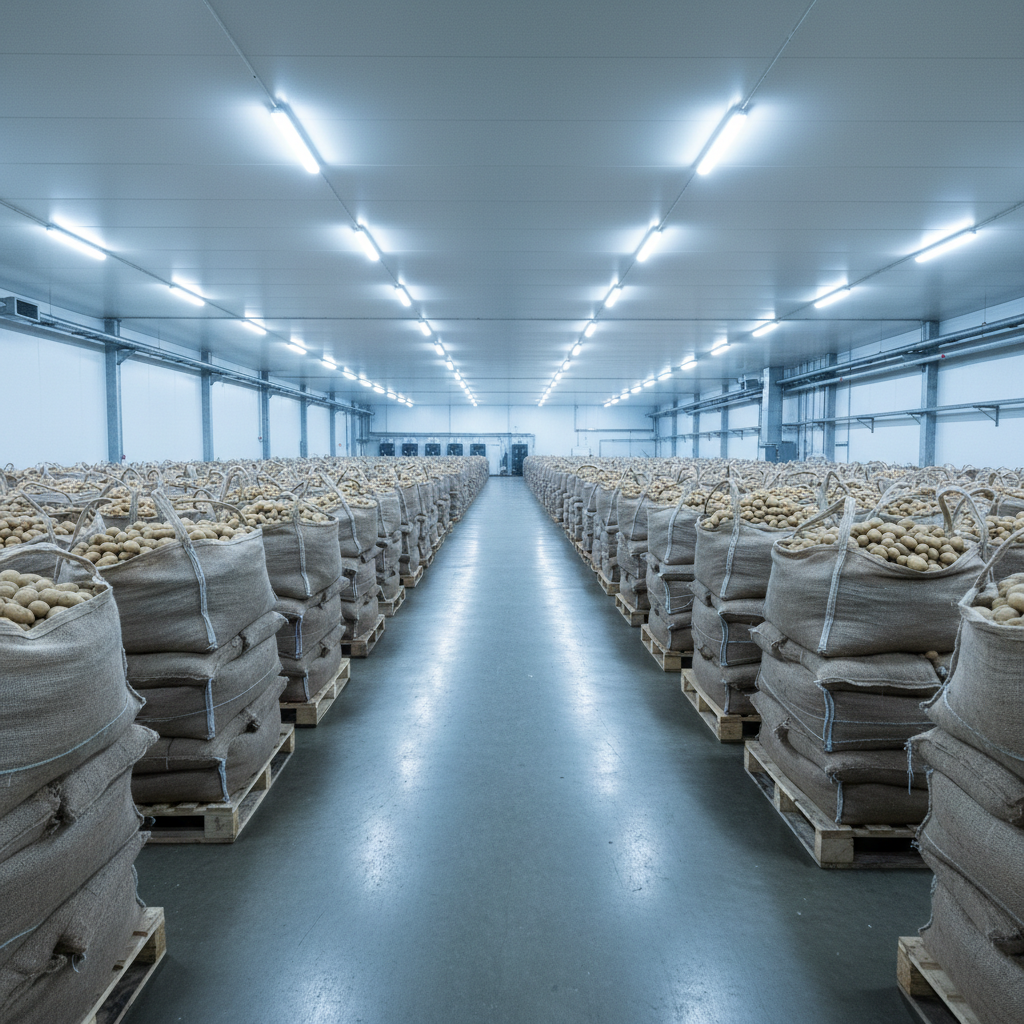
Interior of large agricultural cold store with rows of potato sacks on pallets under fluorescent lighting
Year-Round
Stage 05 — Cold Storage & Dispatch

Cold Storage & Dispatch

Traceability means being able to answer every question before it is asked.

Harvested crop enters our 8,000-tonne cold store within four hours of lifting. Stores run at 4–6 °C with forced-air circulation and CO₂ monitoring to suppress sprouting without chemical sprout suppressant on retail grades. Each pallet carries a lot number linking back to field, harvest date, seed lot, and fungicide record. Food service buyers receive a despatch note with all reference numbers before the lorry leaves the yard.

8,000 tStore capacityForced-air cold store
4–6 °CStorage tempYear-round
48 hrDispatch lead timeFrom confirmed order

Operational Detail

Store temperature: 4–6 °C. Store capacity: 8,000 t. Pallet traceability: field ID, harvest date, seed lot, fungicide programme reference, grading line, pack date. Despatch documentation: delivery note + traceability reference issued before departure. Recall capability: by lot number, pack date, invoice number, or pallet ID. Average despatch lead time: 48 hours from confirmed order.

Procurement Documentation

Download Our Grower's Spec Sheet

Every variety profile, grading tolerance, fungicide withdrawal period, and traceability reference your procurement team needs — before the lorry backs up to the dock.

Variety profiles: Maris Piper, Rooster, King Edward
Grading tolerances (mm) by grade and pack type
Fungicide programme with withdrawal periods
Cold storage parameters and shelf-life data
GlobalG.A.P. certification reference numbers
Traceability chain: seed lot → field → storage → dispatch

Get the PDF

Complete the short form below — takes 30 seconds.

Your name
Company name
Email address
Fill Out Form Below
Live Inventory

This Season's Availability

Updated 25/02/2026. All stock cold-stored at 4–6 °C. Contact us to confirm allocation before submitting a purchase order.

VarietyGradePack SizesDispatch WindowMin. OrderStatusNotes
Maris Piper
45–75 mm25 kg sack · Bulk tonne bag · Loose bulkImmediate – Oct 202620 tAvailableHigh dry matter, low reducing sugars. Ideal for chipping.
Maris Piper
35–45 mm25 kg sack · 2 kg retail pre-packImmediate – Aug 20265 tAvailableSmaller grade for retail pre-pack. Named-grower label available.
Rooster
45–80 mm25 kg sack · Bulk tonne bagImmediate – Jul 202610 tAvailableRed-skinned, nutty flavour. High dry matter, excellent roasting and chipping.
Rooster
35–45 mm2 kg retail pre-pack · 1.5 kg net bagMar 2026 – Jun 20262 tLimitedSmall retail grade. Stock allocated — confirm order by 01/03/2026.
King Edward
55–90 mm25 kg sack · Loose bulkImmediate – Apr 20265 tLimitedFloury, high starch. Traditional baking and roasting variety. Low remaining stock.
King Edward
45–55 mm2 kg retail pre-packPre-order for Oct 20261 tPre-orderNext crop pre-order. Planting confirmed April 2026. Spec sheet available on request.

All weights approximate. Prices on application. GlobalG.A.P. cert. no. available on request.

Request Full Spec Sheet
Procurement Documentation

Download Our
Grower's Spec Sheet

A single PDF covering every number your procurement team needs: variety profiles, grading tolerances in millimetres, fungicide withdrawal periods, cold-storage parameters, and full traceability chain documentation.

🌱

GlobalG.A.P. Certified

Cert. no. available in the spec sheet. Audit trail from seed lot to dispatch note.

🔒

Red Tractor Assured

Full scheme compliance. Inspection records available to verified buyers.

📋

LEAF Marque

Integrated Farm Management. Pesticide use data published annually.

Get the PDF

Four fields. We send the spec sheet immediately.

No marketing. Your details are used to personalise the PDF and confirm your buyer type — nothing more.